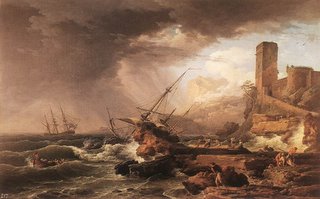
Sunday, April 16, 2006

Christ is Risen! Allelluia!


Most glorious Lord of life, that on this day
Didst make thy triumph over death and sin,
And having harrowed hell, didst bring away
Captivity thence captive us to win:
This joyous day, dear Lord, with joy begin,
And grant that we for whom thou diddest die,
Being with thy dear blood clean washt from sin,
May live forever in felicity.
And that thy love we weighing worthily
May love thee likewise for the same again,
And for thy sake, that all like dear didst buy,
With love may one another entertain.
So let us love, dear love, like as we ought:
Love is the lesson which the Lord us taught.

-- Edmund Spenser, Amoretti 68

Thursday, January 26, 2006

The Beauty of Love

It is the most beautiful, most profound thing written on Love since Plato's Symposium; and it surpasses Plato, because it identifies Love with the God who has come to us in Jesus Christ.

Tuesday, January 17, 2006

Stigma, Signal, Cinquefoil Token for Lettering

So now Hopkins gives us a long meditation on that Tall Nun, from stanza 19 through stanza 31. This is very much the climax of The Wreck of the Deutschland.

Stanza 19 introduces the theme: “Sister, a sister calling/A master, her master and mine!”

Here the Tall Nun is identified, and she calls out even against the storm. Thus our life of Faith is often opposed by the world; it doesn’t take a storm for us to know persecution, though it may take a storm to remind us. Saints and Martyrs provide us, by the romantic, sublime exaggeration of extreme and heroic virtue against the storms of this world’s life, a drama of inspiration. So too does this Tall Nun. And she is pure of heart, authentically directed, well-oriented: “But she that weather sees one thing, one;/ Has one fetch in her.” One fetch!

Stanza 20—“She was first of a five”—gives us the Religious Order of the nuns but at once meditates on the name of the ship and the homeland—“Deutschland”—by ironically juxtaposing St Gertrude & Martin Luther. So here we have a slam broadminded ecumenists would avoid and Lutherans should resent! But while we don’t want to do cartoon history and do to the Protestants what Schiller did to Catholics in Don Carlos, yet we can perhaps see in the juxtaposition of the two Germans, the “lily” and the “beast” a comment on two ways of life—the former, the committed & authentic & vowed life of the Evangelical Counsels, a true Gospel life; and the latter, the renegade, the rebel, the revolutionary. “Lily”, of course, reminds us of both Easter and virginity. “Beast”, beyond the obvious, reminds us of the three beasts “of the waste wood” of darkness and error at the start of Dante’s Comedy—three bestial roots of sin, to be compared to and countered by the three Evangelical Counsels of the Gospel lifestyle of Chastity, Poverty, and Obedience. Here, again, Hopkins is reminding us that his poem is also about the journey of modern Europe—the voyages to America and the revolt of Luther being flipsides of the same story, the breakdown of Christendom. And Hopkins sees this modern story for what it is in theological terms—sin. “From life’s dawn it is drawn down . . .Abel . . .Cain.” Then there is a final image of sucking on breasts. Yes, I know it means Cain & Abel were both babies of Eve, but we cannot help but see the sucking on breasts as an odd, deliberately evocative image in a stanza focused on the authenticity of the Nun. It is a healthy reminder too that the Evangelical life of the Nun does not reject the body, sex, breast-sucking, baby-making, or human culture as bad in themselves—quite the contrary.

Stanza 21—“Loathed for a love”—traces the event of the nuns’ exile in terms both historical and theological. Hopkins links the Hun’s experience of Bismark’s persecution of the Church to the Passion and Sacrifice of Christ. Again, Hopkins theologically sees the whole thing in terms of Love: “Loathed for a love men knew in them” . . .and . . .”They unchancelling poising palms.” And while human eyes would see the sstorm as a storm, Hopkins sees the snow and ice and wind as “scroll-leaved flowers, lily showers.” Once again, God is termed, as before for both the poet’s heart and the Tall Nun, as “Master”, but now “Martyr-master.”

And this theme continues in stanza 22—“Five!”—in identifying the Five Nuns with the Five Wounds of Christ. This stanza is particularly beautiful, especially in the litany—“Stigma, signal, cinquefoil token for lettering . . .ruddying.” No comment can improve the beauty of these lines, but one ritual perhaps reveals them—the stabbing of the Paschal Candle with the five grains of incense signifying Christ’s “holy & glorious wounds”. The phrase “and the word of it Sacrificed” has a direct parallel in form and position to a phrase in the next stanza: “Lovescape crucified.” This next stanza, #23, continues the whole theme with a meditation on the Stigmata of St Francis.

Sister, a sister calling
A master, her master and mine!—
And the inboard seas run swirling and hawling;
The rash smart sloggering brine
Blinds her; but she that weather sees one thing, one;
Has one fetch in her: she rears herself to divine
Ears, and the call of the tall nun
To the men in the tops and the tackle rode over the storm’s brawling.

She was first of a five and came
Of a coifèd sisterhood.
(O Deutschland, double a desperate name!
O world wide of its good!
But Gertrude, lily, and Luther, are two of a town,
Christ’s lily and beast of the waste wood:
From life’s dawn it is drawn down,
Abel is Cain’s brother and breasts they have sucked the same.)

Loathed for a love men knew in them,
Banned by the land of their birth,
Rhine refused them. Thames would ruin them;
Surf, snow, river and earth
Gnashed: but thou art above, thou Orion of light;
Thy unchancelling poising palms were weighing the worth,
Thou martyr-master: in thy sight
Storm flakes were scroll-leaved flowers, lily showers—sweet heaven was astrew in them.

Five! the finding and sake
And cipher of suffering Christ.
Mark, the mark is of man’s make
And the word of it Sacrificed.
But he scores it in scarlet himself on his own bespoken,
Before-time-taken, dearest prizèd and priced—
Stigma, signal, cinquefoil token
For lettering of the lamb’s fleece, ruddying of the rose-flake.

Joy fall to thee, father Francis,
Drawn to the Life that died;
With the gnarls of the nails in thee, niche of the lance, his
Lovescape crucified
And seal of his seraph-arrival! and these thy daughters
And five-livèd and leavèd favour and pride,
Are sisterly sealed in wild waters,
To bathe in his fall-gold mercies, to breathe in his all-fire glances.


Lovescape Crucified!

Sunday, January 15, 2006

The Habit of Perfection

We are pausing at the middle of The Wreck of the Deutschland to consider Hopkins’ vision of the response to the religious Call. And we have been taking a look at earlier poems on this theme—such as Heaven-haven and Halfway House.

And a third early poem comes to mind, while we contemplate the Tall Nun, and while we consider the mystery of The Wreck’s stanza 18—another hymn, perhaps, about a girl joining a convent or a young man joining the priesthood—“The Habit of Perfection.” It’s a gloss on St Augustine’s transfiguration of the senses in “Too late have I loved Thee, O Beauty ever ancient ever new, too late have I loved Thee.” In St Augustine’s beautiful paragraph, each of the five senses is given its full due—touching, hearing, seeing, tasting, even smelling—in full acceptance of the rich sensuous Beauty of the sensation, and then each of the five senses is drawn up towards the source of all Beauty, God. Hopkins’ gloss here is indeed full of the same old, new anarchy of images, of paradox, of contradiction, so fitting for a crux:

ELECTED Silence, sing to me
And beat upon my whorlèd ear,
Pipe me to pastures still and be
The music that I care to hear.

Shape nothing, lips; be lovely-dumb:
It is the shut, the curfew sent
From there where all surrenders come
Which only makes you eloquent.

Be shellèd, eyes, with double dark
And find the uncreated light:
This ruck and reel which you remark
Coils, keeps, and teases simple sight.

Palate, the hutch of tasty lust,
Desire not to be rinsed with wine:
The can must be so sweet, the crust
So fresh that come in fasts divine!


The “can” is the Tabernacle, by the way; the “crust” is the Blessed Sacrament, as in the much later poem, similarly a hymn to Beauty, “The Bugler’s First Communion”: “Forth Christ from cupboard fetched, how fain I of feet/To his youngster take his treat!” Back now to the poem, almost vulgarly to nose & toes:

Nostrils, your careless breath that spend
Upon the stir and keep of pride,
What relish shall the censers send
Along the sanctuary side!

O feel-of-primrose hands, O feet
That want the yield of plushy sward,
But you shall walk the golden street
And you unhouse and house the Lord.


Here I imagine Hopkins imagines himself a Priest who takes and puts the Blessed Sacrament into and out of the Tabernacle. And finally, total simplicity; abject simplicity—and here both Schubert’s Winterreise and Eliot’s Four Quartets can join in :

And, Poverty, be thou the bride
And now the marriage feast begun,
And lily-coloured clothes provide
Your spouse not laboured-at nor spun.


Re-read these three earlier poems—“Heaven-haven” and “The Half-way House” and “The Habit of Perfection”—as a study for the contemplation of The Deutschland’s contemplation of the Tall Nun and the mystery at the heart of its 18th stanza—and so much then becomes clear, indeed rich, indeed One and True and Good and Beautiful!

Thursday, January 12, 2006

Half-way House

And another, slightly later poem comes to mind: “The Half-way House” Hopkins, who has desired to go to a place where springs do not fail—in so many senses—and where not storms come—in a prophetic vision of The Deutschland’s wreck—Hopkins finds himself halfway there in this early poem, on a journey urged by Love:

“Love I was shewn upon the mountain-side
And bid to catch Him ere the drop of day.
See, Love, I creep and Thou on wings dost ride:
Love, it is evening and Thou away;
Love, it grows darker here and Thou art above;
Love, come down to me if Thy name be Love.”


Here, the Road to Emmaus is combined with Tristan & Isolde, with Romeo & Juliet. The religious road is perhaps first an erotic road. Hopkins, the homosexual Oxford student, is on a journey of Love whose “local habitation and a name” he yearns for and has yet to know. But he does see his journey from Protestant English heresy through Oxford Tractarianism toward Rome as a Paschal escape from Egypt:

“My national old Egyptian reed gave way;
I took of vine a cross-barred rod or rood.
Then next I hungered: Love when here, they say,
Or once or never took Love’s proper-food;
But I must yield the chase, or rest and eat.—
Peace and food cheered me where four rough ways meet.”


What a journey Hopkins was on! No wonder he later so sympathized with the Tall Nun and her Sisters on The Deutschland’s journey and wreck! And the “four rough ways” do meet at a crossroads—the Cross-Road, the Way of the Cross, the moment of the Cross, the Crux of the Cross. See how these earlier poem’s elucidate the mystery at the heart of The Wreck of the Deutschland’s stanza 18! And then, Hopkins, as he does in “Part the First” of the later poem, sees the guide for his journey, the compass-point of his love’s confusion and sense of loss, his north pole in the Host, in the Real Presence of Our lord Jesus Christ in the Eucharist:

“Hear yet my paradox: Love, when all is given,
To see Thee I must see Thee, to love, love;
I must o’ertake Thee at once and under heaven
If I shall overtake Thee at last above.
You have your wish; enter these walls, one said;
He is with you in the breaking of the bread.”


God! How stunning, gorgeous, beautiful is Hopkins’ vision! Here, here is the clue to the meaning we avoid! Here is the key to the mystery of The Wreck’s stanza 18: it’s in the “Lovescape crucified!”

Wednesday, January 11, 2006

Heaven-Haven


“Sister, a sister calling
A master, her master and mine!”


These words do sound like Music, even like a madrigal, as promised in the previous stanza’s request for “a madrigal start!”

Here we might pause and remember some earlier poems of Hopkins, poems about the Call, the Response, the yearning for Peace, the erotic desire for a religious life—earlier poems that might shed some light on the mystery of stanza 18 of The Wreck of the Deutschland and on the Voice of the Tall Nun.

Here’s one: Heaven-haven—a nun takes the veil. The fact of the character of a Nun and the reference to a Haven (“Bremerhaven”) reminds me of The Wreck of the Deutschland.

“I have desired to go . . .”

It is the expression of a yearning to go on a journey—a strange link between the chaste longing of a sister entering the convent and the Wagnerian Sehnsucht of Tristan. Hopkins, after all, is a Romantic poet!

“I have desired to go
Where springs not fail,
To fields where flies no sharp and sided hail
And a few lilies blow.”


The reference to lilies reminds me of the fragrance of the lilies in the poetry of St John of the Cross (also contemplated by Balthasar in his Theological Aesthetics), especially On a Dark Night: “ . . .and rest my cares amongst the lilies there.”

“And I have asked to be
Where no storms come,
Where the green swell is in the havens dumb,
And out of the swing of the sea.”


Tristan similarly sings an invitation to Isolde to follow him to a land where the sun shines not. Hopkins penned this Tristanesque lyric as a young man of twenty, while at Oxford, while an Anglican in the midst, like the boy Jesus in amidst the doctors in the Temple, of Walter Pater, Benjamin Jowett, Edward Pusey, Swinburne, Solomon, and John Henry Newman. The meaning is quite clear.

The journey to God is a journey of an erotic desire, from storm to haven, from swelling sea to silent home, from sharp and sided hail to a land of fresh springs and the fragrance of beautiful flowers—that journey of Eros toward the Truth and Goodness and Beauty of God.

Tuesday, January 10, 2006

St Basil on Beauty


In praise of the Beauty of God, this passage sings, today, from the Office of Readings—a selection from St Basil the Great:

“What, I ask, is more wonderful than the beauty of God? What thought is more pleasing and satisfying than God’s majesty? What desire is as urgent and overpowering as the desire implanted by God in a soul that is completely purified of sin and cries out in its love: I am wounded by love? The radiance of the Divine Beauty is altogether beyond the power of words to describe.”

Saturday, January 07, 2006

Her Voice, Her Heart, Hermeneutics

Beginning with the appearance of the Lioness and remaining until stanza 31, which is the start of the final doxology, the poem The Wreck of the Deutschland stands still in eloquent contemplation of the Tall Nun and her Voice!

Stanza 18 is almost a tease, a clever Oxford-common-orom chat. The poet has already addressed the “lioness” and the “prophetess”—and now he calls her a “heart” at the same time. But he teases us—no, he’s not addressing the Nun only but also his own heart: thus the seemingly flippant manner, so wildly seemingly inappropriate for the storm, the wreck, and the martyrdom, but still iconic of holy wit: “Ah, touched . . .are you! Turned . . .have you! Make words . . .do you!” The link, of course, between the Nun and his heart is the man-woman relationship both within the created human personal soul—each person as a person sharing in the fundamental androgyny of humanity, split by gender into Eve & Adam—and between God and the person —we all being feminine before the divine masculine. (This interior androgyny, with reason and imagination, with an interior father and interior mother, is well explored in Hopkins’ poem dedicated to Robert Bridges, “To R.B.”) This whole stanza is particularly dense and difficulty, seemingly unfitting to the context—a witty puzzle juxtaposed to the tragic tale and the invitation to “a madrigal start.” And one of the phrases is seemingly inexplicable—“O unteachably after evil”—perhaps Hopkins referring to his own sinfulness, or at least the moral ambiguity of his poetry-making in his own eyes. But the ambiguity of what the text means at all is predominant: the words all through could refer both to the Nun and also to the poet—linked at “mother of being in me, heart”. The poet expresses an alarm, a surprise that causes both tears and a madrigal: something pent up is being release: “ . . .such a melting, a madrigal start!/Never-eldering revel and river of youth,/What can it be, this glee? The good you have there of your own?”

Perhaps we might unlock the puzzle of this dense stanza (and the whole poem) if we remember that it is telling a tale on three levels---

---the literal tale of the actual wreck of the ship The Deutschland, and the drowning of the Nuns, and the heroic call of the Tall Nun

---the allegorical tale of modern Europe, of the West in wreck, of Germany in particular as the country of rebellion against God, of the attempt to destroy the Church, of the witness of modern Christians

---the moral tale of the interior life of Hopkins the poet himself, both as an artist and as a Christian, which seems to be most of all the poem’s concern, given the lengthy Part One which is a Principle and Foundation of the Spiritual Exercises of the whole

And to this we might add (though not fully yet, because we haven’t finished reviewing The Wreck of the Deutschland in detail) there is a fourth level—an analogical level, which draws the literal story, the allegory of the West, and the personal moral spirituality, all up, up, up into the revelation of the Heavenly reality of the inner life of God the Holy Trinity.

I do think Hopkins indeed intended all these levels, and stanza 18 is the real heart of the puzzle. Perhaps this is best demonstrated by the fact that stanza 18, this enigmatic crux of the poem, is actually the central stanza between stanza 1 and the final stanza 35. No wonder it is a mystery, a question, a strangeness, the place of the intersection of all the ways of reading the poem. It’s the one place in the poem where we don’t really know where we are, where, who, how, what, or when we are. It is the crux of the analogous imagination. And—to risk more complexity—it’s the moment when the poet actually speaks of being so moved as to pen a poem, to utter and to arrange utterances.

Ah, touched in your bower of bone
Are you! turned for an exquisite smart,
Have you! make words break from me here all alone,
Do you!—mother of being in me, heart.
O unteachably after evil, but uttering truth,
Why, tears! is it? tears; such a melting, a madrigal start!
Never-eldering revel and river of youth,
What can it be, this glee? the good you have there of your own?

Tuesday, January 03, 2006

The Sailor & The Nun


In stanza 16, “One stirred”, a brave, generous-hearted sailor tries to save the women, is blown and thrown off the ship, and is swung by a rope in the storm. The horror of the remaining passengers “could tell him for hours, dandled the to and fro.” Perhaps a type of Christ, not that he saved them (because he didn’t) but that he sacrifices himself trying to.

The rhetoric of stanza 17 reminds me of “A voice cries out in Rama—Rachel weeping for her children—and she could not be consoled—because they were not.” That’s the effect, in sound and meaning, of fighting with God’s cold, “and they could not and fell to the deck”, and “crushed them” and “drowned them” and “the crying of child without check”.

All this till a brave Tall Nun, a Franciscan, daughter of St Clare, rises up in the darkness of the night, out of this cinematic storm!

“Till a lioness arose breasting the babble/A prophetess towered in the tumult, a virginal tongue told.”

One can almost hear music at this moment: we are not at first aware that the heroine now is the Nun. I suppose we are presumed to know the story already: but nowadays no one does except readers of Hopkins’ poem. It’s like those moments in Titanic when well-known incidents are suggested (the husband & wife drowning, willingly, in bed together, for example). But either way, we’ll know she’s a Nun soon enough. More than enough for now, we see “a lioness” . . .”a prophetess” . . .a tower . . .and “a virginal tongue told”.

Thus suggested too are the Virgin Mary, Judith, Esther, Deborah. In fact, is it not amazing that the figure of Woman in the biblical tradition is not ever a priestess but rather a Judge, a Warrior, a Prophetess, as a figure of the People of Israel?!? In fact, the whole Litany of the Virgin Mary, with its Tower and City and Queen, is in praise of this heroic Woman.

And up she rises, this Tall Nun, this Tower, this Lioness . . .and now, time will stop for several stanzas as we meditate on this Woman.

One stirred from the rigging to save
The wild woman-kind below,
With a rope’s end round the man, handy and brave—
He was pitched to his death at a blow,
For all his dreadnought breast and braids of thew:
They could tell him for hours, dandled the to and fro
Through the cobbled foam-fleece, what could he do
With the burl of the fountains of air, buck and the flood of the wave?

They fought with God’s cold—
And they could not and fell to the deck
(Crushed them) or water (and drowned them) or rolled
With the sea-romp over the wreck.
Night roared, with the heart-break hearing a heart-broke rabble,
The woman’s wailing, the crying of child without check—
Till a lioness arose breasting the babble,
A prophetess towered in the tumult, a virginal tongue told.

Monday, January 02, 2006

Into the snows she sweeps . . .

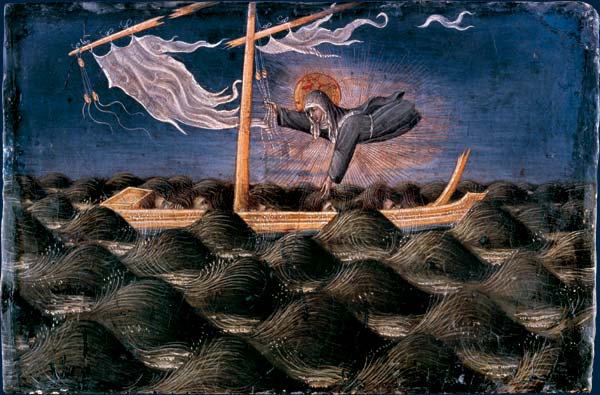
The Deutschland plunges into the North Sea. The overall atmosphere, as at the beginning of Hamlet, is cold and unkindness. And here, we have the name of the ship for the first time in the poem—and it is as striking as it would be in a movie if we first saw the ship’s name in snow & ice & lashing sea, perhaps even lit by a flash and accompanied by thunder & the shrieks of the wind—The Deutschland! Later, in stanza 20, Hopkins will underscore the fitting ironies in the ship’s name—“O Deutschland, double a desperate name!” Of course, little did Hopkins know in 1875 how fitting, how prophetic his poem would be! But for now, for irrational arrogance, the ship is ‘hurling the haven behind.” And it goes into a world that is “unkind” . . .”black-backed” . . .”cursed quarter” . . .”widow-making unchilding unfathering deeps.”

At this moment in the poem we see that Hopkins is as good a storyteller as Stephen King or as good a director as James Cameron or Peter Jackson: every word of the poem plunges, hurts, rips us and makes us have this experience of the voyage and shipwreck too.

In stanza 14, we can see the wreck on the sandbank: moreover, we can hear it, as if it had a soundtrack, with effects and music. And now the ship’s power is broken and she is helpless:

“And canvas and compass, the whorl and the wheel/Idle for ever to waft her or winde her with, these she endured.”

Stanza 15 is about hopelessness, as stanza 11 was about Death. And as the people try to climb into the rigging, “To the shrouds they took.” Again, I am reminded of those breathtakingly sublime images in Titanic, as the passengers try so near despair to climb up the last up-ended end of the mightily defeated ship!

And yet, for all these words of Death and Despair, even in the context of Despair, we hear, over and over, like a bell, ringing, singing, almost as if hear or overhear it, the knell of "Hope."

"Hope . . . Hope . . .Hope!"

The word "Hope" may alliterate with "hurling" and "horrible airs", but Hope is still sounding. And amidst this shipwreck, a great Hope is about to sound, the cry of the Tall Nun!

Into the snows she sweeps,
Hurling the haven behind,
The Deutschland, on Sunday; and so the sky keeps,
For the infinite air is unkind,
And the sea flint-flake, black-backed in the regular blow,
Sitting Eastnortheast, in cursed quarter, the wind;
Wiry and white-fiery and whirlwind-swivellèd snow
Spins to the widow-making unchilding unfathering deeps.

She drove in the dark to leeward,
She struck—not a reef or a rock
But the combs of a smother of sand: night drew her
Dead to the Kentish Knock;
And she beat the bank down with her bows and the ride of her keel:
The breakers rolled on her beam with ruinous shock;
And canvas and compass, the whorl and the wheel
Idle for ever to waft her or wind her with, these she endured.

Hope had grown grey hairs,
Hope had mourning on,
Trenched with tears, carved with cares,
Hope was twelve hours gone;
And frightful a nightfall folded rueful a day
Nor rescue, only rocket and lightship, shone,
And lives at last were washing away:
To the shrouds they took,—they shook in the hurling and horrible airs.


Yes, there is Hope to come!

Monday, December 26, 2005

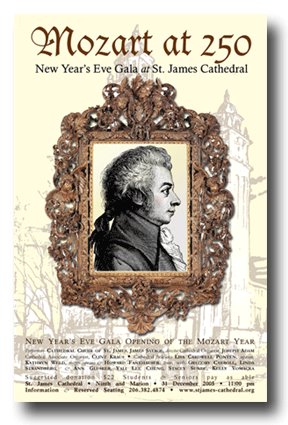
Celebrate the New Year at St James Cathedral

This coming New Year's Eve, a fantastic way to celebrate the New Year is the gorgeous Mozart at 250 at St James Cathedral in Seattle.

This concert features the 60-voice Cathedral Choir of St James, the organists Joseph Adam and Clint Craus, the beautiful voices of the Cathedral soloists, all directed by Dr James Savage--all singing and making music Mozart composed all through his life for the glory of God's Beauty!

It's Saturday 31 December 2005, at 11:00pm at St James, 9th & Marion, in Seattle. What a beautiful way to ring in and sing in the New Year!

Thursday, December 15, 2005

Take Her to Sea!

And then the tale, at long last, begins.

A real story, a true story, like that of the Titanic. “On Saturday . . .”sings stanza 12. The true tale of the voyage and wreck of the Deutschland. And the origin and goal of the voyage—from Bremen to America—have their won romantic significance: it is the journey, the quest, the westward expansion, the “American-outward-bound” of the European nations and peoples for four hundred years before Hopkins’ own time. And even with all the details, facts, acts, events of European history, the one Big Story since about 1500 is “American-outward-bound”—a story also synonymous with the break-down of Christendom.

While the passengers believe they are going to America—to newness, to expansion, to freedom perhaps, to the new horizon of “American-outward-bound”—they little know they are doomed, that a fourth of the passengers would die and the others be irrevocably marked, like the survivors of the Titanic, by the forever-altered awareness, in horror, of mortality. Telling this tale as the symbolic meaning of modern European history is fitting, because the ideologies of the modern era—materialism, secularism, capitalism, communism, atheism,--all not only deny God but also deny Death, or rather, not deny Death but ignore Death even while promoting Death.

The chug-chugging along, full ahead, of a big modern engine-powered ship in westward transatlantic crossing is a terrific symbol of the spiritual condition of modern Europe. Of course, we don’t mean, nor did Hopkins, that there’s anything wrong about sea-travel; after all, Dante used the image of a boat all through his Comedy as the image of the soul, the human reality, the Church, and the spiritual life. But the modern powered-ship is rather like an airplane or a rocket—the wonder, near-divine, of modern Man; and something like September 11th or the Space Shuttle disaster, which reminds us of our mortality and fallibility, all the more strikingly glaring in the context of our arrogance. Though modern man be modern, he is no more divine than medieval or ancient man or even cave-man. Man is Man, or “dust!” Yet, yet once we admit Death, then we can start to see the reality of God’s love and blessing.

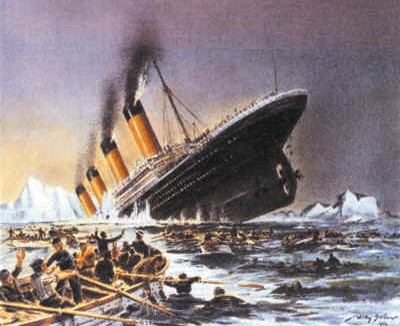
The 1875 voyage of the Deutschland was as real as the voyage of the Titanic—and on board were those nuns, fleeing the anti-Catholic laws of the newly united Germany (“Deutschland”, by the way, soon to be wrecked!). Thus Hopkins has set up, in this telling of the tale, a real thing which can carry the spiritual significance of the boat in Dante. What magic and what blessing will be in its telling!

On Saturday sailed from Bremen,
American-outward-bound,
Take settler and seamen, tell men with women,
Two hundred souls in the round—
O Father, not under thy feathers nor ever as guessing
The goal was a shoal, of a fourth the doom to be drowned;
Yet did the dark side of the bay of thy blessing
Not vault them, the million of rounds of thy mercy not reeve even them in?

Wednesday, December 14, 2005

Death in the Wreck

The opening stanza of Hopkins' great poem's second part is about Death.

Death. A painful, ugly topic--yet a fact, a universal fact for every one of us.

This stanza, stanza 11, is a meditation on Death--putting the entire poem in the context of Death. "Dust!" is our universal, common destiny. Death is a real thing--metaphysical debates aside. Perhaps this is why tales of shipwreck are so effectively romantic--because a tale of a shipwreck mythologizes our common fate. We are all on the Titanic, all on the Deutschland.

Hopkins has Death speak and use the many names, many experiences, by which people encounter Death--sword, flange, rail, flame, fang, flood. But the image of the shipwreck is a powerful poetic image that puts us all on the deck of Death.
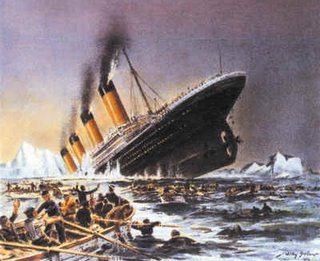
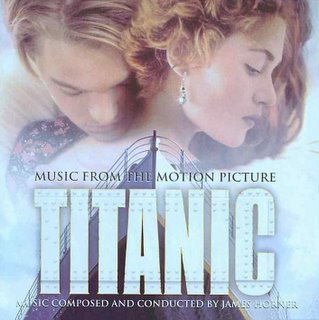
Perhaps that is why the greatest cheezey movie of all time--James Cameron's Titanic--was so powerful a film for so many millions of people. Despite the inelegant dialogue, the tale of Leonardo di Caprio & Kate Winslett on the Titanic was a kind of romantic universal myth of the situation of everyone--in the face of the fact of Death, the point is how we face it, what we do, how we act, to what and to whom do we give outselves. Some choose to struggle for life against everyone else, some with a few others; some make their art or their music, while some do their duty of rank or office; some kill thmselves in despair, some just get drunk; and some--Jack & Rose in the movie--offer themselves for each other in a self-sacrificial romantic Love that prefigures Christian love and Christ's sacrifice. No wonder Rose uses words like "He saved me."!

In the face of Death, Leo (Jack) & Kate (Rose) live for Love. Their romantic, secular example in Titanic is a myth for all of us: since we are all on the Titanic, since we are all, inevitably, ultimately, every one of us, going to die, thus how we face that absolutely real fact is the very existential definition of our lives. In Titanic, we weep with a grief that is Joy for Leo & Kate, for Jack & Rose, because in the face of Death they live for Love. And like Titanic, Hopkins' poem is of the same genre--in the face of Death, a Tall Nun calls out "O Christ, Christ, come quickly!" And like Titanic, Hopkins' poem, through exploring the most profoundly sad experience, ultimately expresses not only Hope but joyful, glorious Hope! But for that Hope to be truly Hopeful, we must first risk hopelessness in the real fact of Death. "All flesh is grass, and its beauty is the beauty of the flowers: the flowers wither, the grass fades, but the Word of the Lord remains forever!"
Hopkins' second part of the "Wreck" reminds us that in the midst of life we are on the deck of a sinking ship:

‘Some find me a sword; some
The flange and the rail; flame,
Fang, or flood’ goes Death on drum,
And storms bugle his fame.
But wé dream we are rooted in earth—Dust!
Flesh falls within sight of us, we, though our flower the same,
Wave with the meadow, forget that there must
The sour scythe cringe, and the blear share come.

Sunday, December 11, 2005

The Rest of the Wreck

Hopkins’ great Wreck of the Deutschland unveils the reality of Christ and the human person in the tale of the wreck of a ship, the Deutschland, in a storm in the Thames—a ship coming from Bremen en route to America. Amongst the passengers were a group of Franciscan nuns, exiled from Germany on account of the anti-Catholic German laws of the time. That their exile was also the hour of their death by drowning became a symbol for Hopkins of the reality of human life in our difficult world, but also an inspiring account of the nuns’ witness to Christ by unity with His cross.

As the First Part--the first ten stanzas--served as a kind of “First Principle and Foundation” or spiritual background of the encounter between God and the human person, so now the Second Part tells the story of the ship, the storm, the wreck, and the heroic witness of one of the nuns, whom we will call the Tall Nun, who calls out, “Christ, come quickly” at the climax of the poem.

Hans Urs von Balthasar pointed out in The Glory of the Lord:

“But the ultimate for Hopkins remains still his shipwreck poems, because here the foundering and shattering of all worldly images and symbols yield a final picture of the sacrament of the world: perishing and ascending to God—death as Resurrection: Resurrection not beyond death but in death. The nun on the foaming deck, who from the midst of the tumult of the elements cries ‘Christ, come quickly’—she cries to her Redeemer in and through the elements: ‘christens her wild-worst Best.’ The wreck is as a harvest (‘the goal was a shoal’); everything alive was washed away (‘lives at last were washing away’). Foundering in God—that is the high point of the poem—man finds nothing more to cling on to, not his longing nor reward nor Heaven nor any of God’s attributes, for beyond all that there is nothing but Him alone: ‘Ipse, the only one’—the self beyond any nature. Here the poet rejoices because the ‘heart right’ (cor rectum), the ‘single eye’ of the parable, is capable of the highest: to interpret the formless and unformable chaos of the night as form and in the senselessness of pure question to know the who and the why.”

So let’s explore this “Second Part” of Hopkins’ great poem as we await the coming of Christ!

Sunday, November 13, 2005

Godhead here in hiding

Gerard Manley Hopkins offers this translation of the famed Eucharistic hymn of St Thomas Aquinas, Adoro te devote.

Godhead here in hiding, whom I do adore,
Masked by these bare shadows, shape and nothing more,
See, Lord, at thy service low lies here a heart
Lost, all lost in wonder at the God thou art.

Seeing, touching, tasting are in thee deceived:
How says trusty hearing? that shall be believed;
What God's Son has told me, take for truth I do;
Truth himself speaks truly or there's nothing true.

On the cross thy godhead made no sign to men,
Here thy very manhood steals from human ken:
Both are my confession, both are my belief,
And I pray the prayer of the dying thief.

I am not like Thomas, wounds I cannot see,
But can plainly call thee Lord and God as he;
Let me to a deeper faith daily nearer move,
Daily make me harder hope and dearer love.

O thou our reminder of Christ crucified,
Living Bread, the life of us for whom he died,
Lend this life to me then: feed and feast my mind,
There be thou the sweetness man was meant to find.

Bring the tender tale true of the Pelican;
Bathe me, Jesu Lord, in what thy bosom ran---
Blood whereof a single drop has power to win
All the world forgiveness of its world of sin.

Jesu, whom I look at shrouded here below,
I beseech thee send me what I thirst for so,
Some day to gaze on thee face to face in light
And be blest for ever with thy glory's sight. Amen.

Saturday, November 12, 2005

Hopkins' God, Three-Numbered Form

So now for the rest of the stanzas of "Part One" of The Wreck of the Deutschland. Remember, these first ten stanzas are rather like a meditation on God and the person, rather like a "first principle and foundation" for the "spiritual exercise" that is the "Part Two", the tale of the exiled & drowned nuns. These ten stanzas explore the relationship of God and the person, climaxing in a doxology to the Holy Trinity.

“Not out of his bliss”—Stanza Six—describes the stress, explores God’s instressing of the World—which Hopkins deems not as easy and cheap grace but rather as a “stroke and a stress” in a moment of time, in reality. We meet God in “stars and storms”, and “it rides time like riding a river.” The “river” here is many things—the river of life, the river of the Red Sea, death & life both, the water of baptism, the moment of conversion and transformation and Paschal Mystery.

And in Stanza Seven, Hopkins describes the stroke as the intervention, the eruption, the love-stroke of God into human history—the Incarnation. Thus Hopkins describes and makes visual in erotic terms the theology of Nature and Grace. And he indicates that this doctrine is a real historical actual thing that not all men actually know, “faithful” and “faithless”. I like the phrase “the faithless fable and miss”, because it implies a real Beauty at first in fables that ultimately remains unfulfilled because unreal; and it reminds me of the phrase in the very first stanza of the whole poem—“I feel they finger and find thee”—because it implies that the Christian relationship with God is no fabling that fails but a real lovemaking, because it is a real thing. “It dates from day of his going in Galilee.” And even the imagery of the river in these two stanzas is erotic—“hushed” . .”flushed” . . .”melt” . . .”riding a river” . . .”waver” . . .”fable and miss” . . .”dense . . .driven” . . .”sweat” . . .”discharge” . . .”swelling” . . .”felt” . . .”high flood” . . .and since it’s all about the heart whose guilt is “hushed”, so now this heart is “hard” . . .and then, in Stanza Eight, is “Is out with it !Oh, we lash with the best or worst word last!” That’s all pretty sexy penning to describe Grace and the specifics of the Incarnation and the Paschal Mystery. But there it all is—and Hopkins thus in his poem-making celebrates the very flesh of the God-made-flesh!

And this beautiful penning becomes almost exciting in this Stanza Eight, more so perhaps even than Melville in the famed chapter in Moby Dick, in which the whalers celebrate in the very sperm and flesh of the sperm-whale. Hopkins' image for it here is a plum a "sloe" and how it bursts on the tongue and face. It is the real encounter with the living God, Incarnate, present, linked to the real Calvary, His real “feet”, and it is an experience of real Grace, no mere intellectualizing: “Never ask if meaning it, wanting it, warned of it—men go!” Our relationship with God is more exciting than anything! And the love-nest of this relationship is the nest of an Altar, the Altar of the Cross.

And the result—Doxology! “Be adored among men” begins Stanza Nine, in an invocation of the “Three-numbered form” of the Holy Trinity, and an act of gratitude that God’s Love can be found even in our suffering, “with wrecking and storm.” And this “lightning and love” is “past telling of tongue”, as St Paul once wrote, but yet Hopkins, in his jammed and crammed and crunched poem tells it.

Stanzas Nine & Ten are a prayer for conversion, like St Paul’s or St Augustine’s. Indeed, for a forging. As is all Christian spirituality—but oh, how much more exciting, more beautiful, more flesh-evocative is Hopkins’ poem than the insipid and pallid phrase “Christian spirituality” which so easily goes Gnostic. Hopkins’ sacramental poetry saves spirituality from itself!

Enough of my commentary. Read it all here for yourself . . .and remember, it’s all an Ignatian First Principle and Foundation for the tale of the exiled nuns, the Wreck of the Deutschland (that phrase itself has multiple meanings!) and real faith in Jesus Christ!

Not out of his bliss
Springs the stress felt
Nor first from heaven (and few know this)
Swings the stroke dealt—
Stroke and a stress that stars and storms deliver,
That guilt is hushed by, hearts are flushed by and melt—
But it rides time like riding a river
(And here the faithful waver, the faithless fable and miss).

It dates from day
Of his going in Galilee;
Warm-laid grave of a womb-life grey;
Manger, maiden’s knee;
The dense and the driven Passion, and frightful sweat;
Thence the discharge of it, there its swelling to be,
Though felt before, though in high flood yet—
What none would have known of it, only the heart, being hard at bay,

Is out with it! Oh,
We lash with the best or worst
Word last! How a lush-kept plush-capped sloe
Will, mouthed to flesh-burst,
Gush!—flush the man, the being with it, sour or sweet,
Brim, in a flash, full!—Hither then, last or first,
To hero of Calvary, Christ, ’s feet—
Never ask if meaning it, wanting it, warned of it—men go.

Be adored among men,
God, three-numberèd form;
Wring thy rebel, dogged in den,
Man’s malice, with wrecking and storm.
Beyond saying sweet, past telling of tongue,
Thou art lightning and love, I found it, a winter and warm;
Father and fondler of heart thou hast wrung:
Hast thy dark descending and most art merciful then.

With an anvil-ding
And with fire in him forge thy will
Or rather, rather then, stealing as Spring
Through him, melt him but master him still:
Whether at once, as once at a crash Paul,
Or as Austin, a lingering-out sweet skill,
Make mercy in all of us, out of us all
Mastery, but be adored, but be adored King.

Friday, November 11, 2005

Balthasar on Hopkins

The remaining stanzas of “Part One” of The Wreck of the Deutschland well sing of that personal wrestling-relationship between the person and God—which Hopkins himself certainly experienced, in his vocation as a Poet, yes, and most of all in his vocation as a Jesuit.

Balthasar, in The Glory of the Lord, describes this relationship quite exquisitely---“the always unique oneness of the individual form that only emerges in the Christian encounter between the absolutely personal and free God and the fully personal creature—here alone truly ‘monos pros monon’ [alone with the Alone]—and just this fundamental experience had to lead Hopkins back to Ignatius and his Spiritual Exercises, where for the first time in the history of Christian spirituality everything is placed on the knife edge of the mutual election that takes place between God and man, behind which retreats any consideration of ‘perfection in general’. Here are dissolved all the confusing clouds of the mythical in order to uncover the absolute, hard reality in which alone the true glory of being shines forth.”

We certainly experience this poetically, most strongly, in Stanza Five—“I kiss my hand”. It is a salute, a loving salute to God in starlight, thunder, and sunset. One is reminded of the chivalric courtesy of Ignatius, as well as the romantic gestures of all poets, the total giving, the gratuitous generosity, the particular hard reality and the sweet spectacular uniqueness of a Vocation and a Response. “I kiss my hand” to God’s revelation of His Beauty, in the here and now, and in the beyond.

We are reminded, too, that gazing upwards at the stars is a sign of Man’s eternal vocation and destiny. And here too Hopkins describes God as the instress of the World—the energy, the be-ing, the let-be-ing that makes the World both that it is and what it is. Hopkins also indicates at least two modes in which he knows God—when he meets or experiences Him, and when he understands Him. And that the poet says “and bless when I understand” hints that real understanding happens only once in a while. But the salute, the generous gesture, is the continual response to the Call, the response to Beauty!

I kiss my hand
To the stars, lovely-asunder
Starlight, wafting him out of it; and
Glow, glory in thunder;
Kiss my hand to the dappled-with-damson west:
Since, tho’ he is under the world’s splendour and wonder,
His mystery must be instressed, stressed;
For I greet him the days I meet him, and bless when I understand.


Balthasar saw & heard this vision of Beauty in Hopkins' sacramental poetry!

Thursday, November 10, 2005

Hopkins' Wreck's Relationship

These first ten stanzas of Hopkins’ The Wreck of the Deutschland form “Part One” of the poem---and they sing the wrestled relationship of the person and God. “Part Two” sings the tale of the death by shipwreck & drowning of the exiled German nuns.

Stanza Four is repose after sudden climax—“I am soft sift”—but it is an active, acted up repose that is still a responsiveness: and that is the Gospel lifestyle. In these dense, rich metaphors, Hopkins gives us a vision of the Beauty of a lifestyle of Grace. Such a life is like two things—sand in an hourglass, water in a well. Either way, we cling to Him, spent, spending, suspended. “Hourglass”, of course, implies time, irreversible, moment by moment, hour by hour, in which we live. And the Gospel lifestyle is one of motion—like, perhaps,in a third image, a ship roped to the dock, roped with the strictures of Christ, which are described as “a vein”. And we know whose vein, and we know our veins too. Thus Hopkins jams more meaning in, almost more than any one word can carry. Thus he is like Pindar and Virgil.

This lifestyle of Grace—“Christ’s gift.” Hopkins shows us—and this is why Balthasar so emphasizes Hopkins in The Glory of the Lord—the Beauty of the relationship with Christ.

I am soft sift
In an hourglass—at the wall
Fast, but mined with a motion, a drift,
And it crowds and it combs to the fall;
I steady as a water in a well, to a poise, to a pane,
But roped with, always, all the way down from the tall
Fells or flanks of the voel, a vein
Of the gospel proffer, a pressure, a principle, Christ’s gift.

Wednesday, November 09, 2005

The Wreck's Wrestling-Match

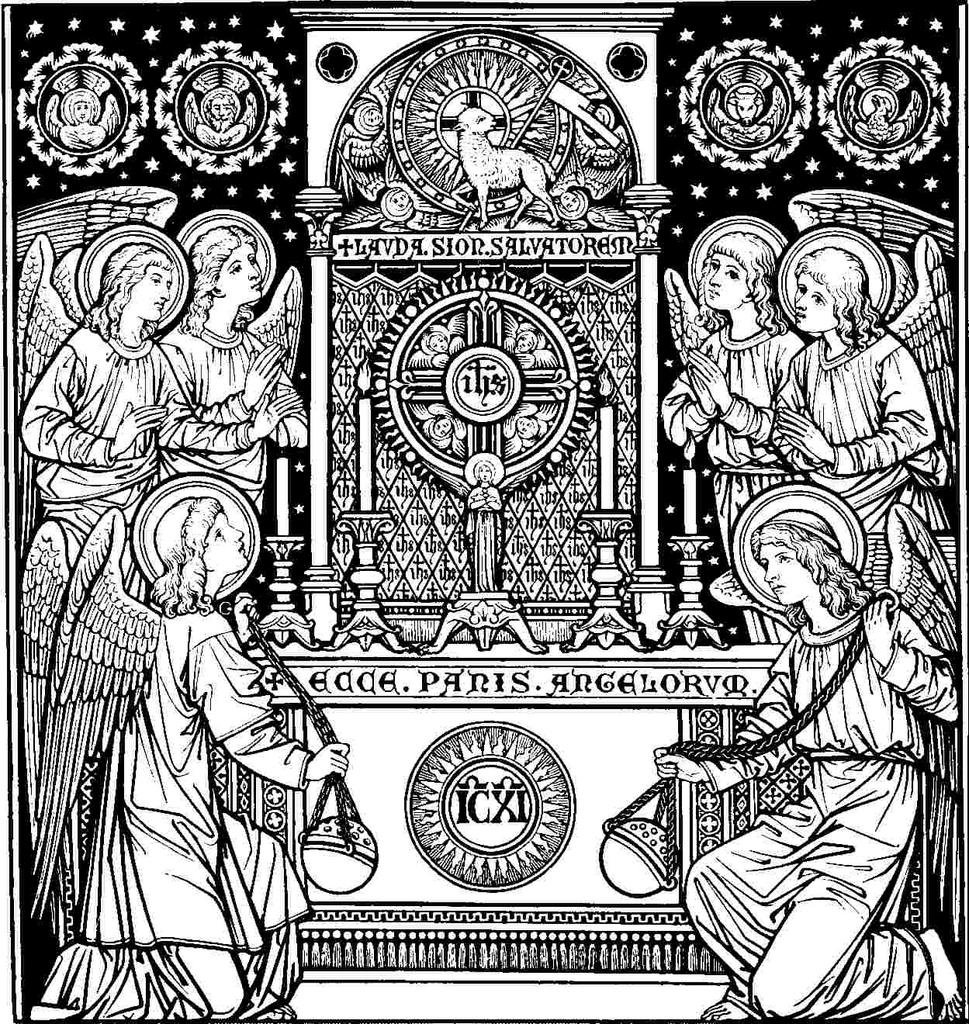
The first three stanzas of The Wreck of the Deutschland are as erotic as Tristan und Isolde and describe a three-part climax of spiritual movement—1) God’s mastering call; 2) the person’s swooning response; and 3) the explosion of union. And they root this love-making in the Blessed Sacrament at Mass, or in the Tabernacle during an hour of silent adoration, the “Host” . . .and further, “with a fling of the heart to the heart of the Host”. This is no mythic generalized spirituality but rather a real thing, a real love-making with the real God Who became a real Man in Jesus Christ, sacrificing Himself on the Cross and rising from the dead, ascending to this Father and sending His Holy Spirit so that we could encounter Him, know Him, and become one in Him in the Eucharist.

I did say yes
O at lightning and lashed rod;
Thou heardst me truer than tongue confess
Thy terror, O Christ, O God;
Thou knowest the walls, altar and hour and night:
The swoon of a heart that the sweep and the hurl of thee trod
Hard down with a horror of height:
And the midriff astrain with leaning of, laced with fire of stress.

The frown of his face
Before me, the hurtle of hell
Behind, where, where was a, where was a place?
I whirled out wings that spell
And fled with a fling of the heart to the heart of the Host.
My heart, but you were dovewinged, I can tell,
Carrier-witted, I am bold to boast,
To flash from the flame to the flame then, tower from the grace to the grace.


Stanza Two confirms this metaphor of the wrestling with God: “I did say yes.” It is a wrestling at night, at prayer, in a chapel—and it is a “swoon” and a “sweep” and a “hurl” and a “midriff . . .laced with fire of stress.” It is a moment when Hopkins says Yes to the call of God—in his own life, perhaps the call to join the Roman Catholic Church or to enter the Jesuits, or perhaps some other night of prayer. It is a moment of a response to God, and an urgent response to an urgent call. This is a real experience, a real thing, . . .and it has been so in the lives of many real Christian persons.

Stanza Three---“the frown of his face” is God’s judgement ahead, “the hurtle of hell” is the penalty, and the person becomes a “dovewinged” dove, “carrier-witted” who flies at the Blessed Sacrament in an aim described as both “fire” and “grace.” Even this climax of rest is an explosion.

Balthasar sees that Hopkins’ poem is the landscape on which the real person encounters the real God—especially in the hour of decision, of choice, of answer, of personal response to a call, of personal vocation, of encounter.

Monday, November 07, 2005

Hopkins' Masterpiece

The Wreck of the Deutschland, of course, is Hopkins’ masterpiece—an artistic and a moral masterpiece. For in a Crisis of Impossibility, it is a cry of Faith.

The drama of the poem’s occasion—the death of the exiled German nuns by shipwreck—and the drama of the poet’s situation—the wrestling-match of the encounter between the real person and the real God—are revealed in the poem’s first word, “Thou”, and the poem’s last word, “Lord”. The poem is “Thou Lord.” And everything in-between is the Paschal Mystery—the relationship between the human person and Jesus Christ.

The first stanza—“Thou mastering me God!”—sings with an almost erotic frankness of the wrestling-match of God and the person. God is awesome—as master, creator, teacher, dread doom, divine and human savior. Merely the perception of God, merely the experience of God, merely the addressing of God in the daring, wonderful, heatbreaking syllable “Thou” reveals more theology than all the intellectual constructions of the philosophers, as Pascal knew.

And while I’m certain Hopkins did not wittingly intend an erotic aura, I cannot help but notice that this stanza, concerning the relationship between the real person and the true God, all following the invocation “Thou”, includes a progression of words—“mastering me” . . .”breath” . ..”sway” . . .”bound bones and veins” . . .”fastened me flesh” . . .”touch me afresh” . . .”over again” . . .”feel” . . .finger” . ..”find”. Of course, Hopkins pens in the tradition of The Song of Songs and the canticles of St John of the Cross.

No wonder Balthasar chose Hopkins as a star in the constellation of The Glory of the Lord!

Thou mastering me
God! giver of breath and bread;
World’s strand, sway of the sea;
Lord of living and dead;
Thou hast bound bones and veins in me, fastened me flesh,
And after it almost unmade, what with dread,
Thy doing: and dost thou touch me afresh?
Over again I feel thy finger and find thee.